Showing posts with label Australia. Show all posts

Thursday, October 18, 2007

FRIDAYS HISTORY LESSON: MILDURA.... Lock 11


The Lock was designed and built in the 1920s and 1930s to provide pools for irrigation and allow for boats to move along the Murray River year-round regardless of water levels. Today the locks allow paddleboats, houseboats, cruise and recreational craft to move up and down the river. (There is a strange looking handle bar like device in the middle of the grass there..do you see it? This was the device that was made redundant that would have been seen in operation up until the 1970's which used to operate the Lock.)

Mildura Weir and Lock 11 are separated by an island, and are popular places for pelicans and locals who fish for carp, perch, cod and bream. Walking from one side of the river, just over the little metal walk bridge and stepping onto the other side takes you from Victoria to New South Wales. Actually, if you were to step one foot in the water you would have one foot in NSW and the other in Victoria.

Once an important trading route, the Murray River was busy with boats carrying supplies to and carting wool from the region's stations and homesteads. Today visitors can board an historic paddle steamer or paddleboat in the river towns of Mildura and Wentworth to experience this traditional form of travel and find out more about riverboat history. It truly is spectacular and romanic!!


To see the Lock in opertation just clink on my photobucket link HERE. It sure is amazing!!!


Thursday, September 20, 2007

FRIDAY HISTORY POST: Dromkeen.

Dromkeen is a graceful nineteenth-century homestead that has been classified by the National Trust, and accredited through Museums Australia - Victoria. It is situated in the small township of Riddells Creek, outside Melbourne in Victoria. It is the home of the Australian Children's Literature Collection, a unique collection of original artwork, manuscripts and other pre-publication material from Australian children's books.


DROMKEEN HISTORY:
At the turn of the century, Dromkeen was the home of Judge Arthur Chomley, who presided over the County and Supreme Courts of Victoria. His country estate, built in 1889, was named ‘Dromkeen’ to maintain a connection with his mother’s family home at Tipperary in Ireland.
In 1973, Dromkeen was purchased by Joyce and Court Oldmeadow. They used the homestead as a private residence and as a bulk store and freight centre for their educational bookshop. Before long their love and interest in children’s literature led to the establishment of the Dromkeen Collection, and Joyce and Court's house became a home for Australian children’s literature.


Joyce and Court Oldmeadow dedicated their lives to preserving for public display the original artwork and manuscripts of Australian children’s literature, many of which had hitherto been lost or destroyed. Passionate in their desire to inspire children with the creative processes of children’s books in the making, they also wished to preserve this unique part of Australia’s heritage as a ‘living’ collection for everyone to enjoy.
Court Oldmeadow died in 1977, and in 1978 Scholastic Australia took over the responsibility of maintaining the Collection.
Joyce Oldmeadow continued to develop Dromkeen. In 1982, she inaugurated the Dromkeen Medal, which is awarded annually to an Australian citizen whose work has significantly contributed to the appreciation and development of children's literature.
To guarantee a permanent home for the Collection, Scholastic Australia purchased the homestead in 1985.
Joyce Oldmeadow died in 2001. Daughter Kaye Keck continues her parents' legacy as the present Director of Dromkeen.
Scholastic's involvement fulfils Joyce and Court Oldmeadow's dream that the Dromkeen Children's Literature Collection should be available for children and adults alike as a constant source of enjoyment and inspiration.


Possum Magic
Author: Mem Fox

The Dromkeen Collection is a priceless exhibition of original artwork and manuscripts from our continuing heritage of Australian children's literature. Dromkeen also boasts fine gardens with Australian and English plants and trees.
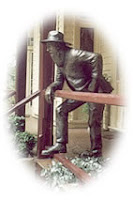

The Man from Ironbark
Author: A B ('Banjo') Paterson

Children's literature comes alive through bronze garden sculptures, and the gazebo provides a welcome resting place following a walk around the Heritage Trail. You can picnic in the extensive gardens, or go visit some of the neighbouring wineries after you leave Dromkeen.


I remember fondly my first trip to Dromkeen as a child with my school. An Australian Author read one of her books to us and we sat in the garden near those sculptures o listen to her. The illustrator was also there. It is a magical place. And so, my love of books began here.. Mr Lizard and Gumnut Baby
Author/Illustrator: May Gibbs


My favourite thing of al here is the writing on the plaque accompanying the very top image hre on this post. It reads "Visitors will be captivated by characters from Australian Children’s stories including Koala Lou, Wombat Divine, Shy the Platypus and the inspiring dragon representing the children’s Dromkeen Dragons club."
Do visit and do touch!

Friday, September 14, 2007

FRIDAY'S HISTORY LESSON: AUSSIE WORD "FURPHY".


A furphy, also commonly spelt furfie, is Australian slang for a rumour, or an erroneous or improbable story.

An original Furphy
The word is derived from water carts made by a company established by John Furphy: J. Furphy & Sons of Shepparton, Victoria. Many Furphy water carts were used to take water to Australian Army personnel during World War I. The carts, with "J. Furphy & Sons" written on their tanks, became popular as gathering places where soldiers could exchange gossip, rumours and fanciful tales.
Originally it was synonymous with "rumour" and "scuttlebutt", but the modern meaning (especially in Australian politics) is "an irrelevant or minor issue raised to specifically divert attention away from the real issue".
A scuttlebutt, however, originally was a term for a cask of drinking water on a ship.
DESCRIPTION: furphy n. (pl. furphies) 1 a false report or rumour. 2 an absurd story. • adj. (furphier, furphiest) absurdly false, unbelievable: that’s the furphiest bit of news I ever heard.
This Ozword comes from the name of [John] Furphy, a blacksmith and general engineer, who went to Shepparton from Kyneton in 1871 and set up a foundry. John Furphy designed a galvanised iron water-cart on wheels and his firm, J. Furphy & Sons, manufactured them. Each cart had the name FURPHY written large on the body. So successful were these carts that during World War 1 the Department of the Army bought many Furphy carts to supply water to camps in Australia and especially to camps in Palestine, and Egypt.


So there you have it!

Thursday, September 06, 2007

FRIDAY HISTORY POST: Hurstbridge..

30 kilometres north-east of Melbourne you will find the quaint town on Hurstbridge. Regular readers will recall my family outing to this lovely town aboard the steam train a few weeks ago for the Wattle Festival.


Railway in Hurstbridge.

The extension of the railway to Hurstbridge in 1912 was primarily to service the local fruit growing area, but it was also responsible for the early growth of the Hurstbridge Township.
Most of the early growth was centred along the Main Street, on land subdivided by Frances and Bill Gray and occurred between 1912 and the mid 1920s.
Several of the older buildings, shops and houses along the main road are good examples of the architectural styles of that time.

The majority of the Hurstbridge township area was not subdivided into residential blocks until after the Second World War (1945-46). Electricity came on in 1957.
The coming of the railway changed many things and gradually produced a change in the population and the work patterns and opportunities for the residents.
It was then possible to reside in the pleasant bushland setting of Hurstbridge and work in the city, much as the people do today. Getting there by train takes 50 minutes on the Melbourne-Hurstbridge line.


Settlement of the area.


The Wurundjeri people were the traditional owners of the country that extended from where Melbourne now stands to Mt Macedon and Healesville. The Wurundjeri spoke the Woiworung language and, with other tribal groups, was part of the Kulin nation.
The Wurundjeri Willam clan lived around this local area for at least 40,000 years in small family groups.
Their descendants still live in the Melbourne area, with a strong community centred around Healesville, in the Yarra Valley.
In 1841 Cornelius Sharp Haley took up, from the Government, the 'Allwood' run. Haley ran cattle and horses and built a slab hut close to where the present Allwood House stands.
Henry Hurst, a surveyor, came to Victoria, from England in 1852.
In 1859 he moved to 'Allwood to manage 160 acres for Cornelius Haley. In about 1865 Henry's parents Frances and Robert Hurst and some of their seven children joined Henry at the Allwood run.
It was about this time that Henry built the first log bridge across the Diamond Creek. This was soon known as 'Hurst's Bridge'.
On the 4th of October 1866 Henry was fatally wounded by a bushranger, Robert Bourke. Bourke was captured and was tied to a wheel of a wagon under a tree (now known as Bourke's Tree) until Sergeant Fawcett and Trooper Hall from Queenstown arrived. Bourke was tried, found guilty of the murder of Henry Hurst and was later hanged.
Come on, visit this lovely area.

Browse the local antique shops, including the Old Tin Shed
Follow the Hurstbridge Heritage trail around the town and learn about its early pioneer beginnings. Collect a brochure from a local Visitor Information Centre
View kangaroos in the wild on the town outskirts
Stop at a local café for good coffee or enjoy vegetarian and organic fare at Chocolate Lily.
You may care to visit the Yarra Valley wineries (five of which are within 10 minutes drive of the town centre). Interstate and international visitors, quite often make Hurstbridge their base and go into the city by train on the Hurstbridge Line, or take day trips to the Yarra Valley or the Dandenong Ranges.

Oh, and every weekend there is live music played out in the main street during the month of October too :)


Thursday, August 23, 2007

FRIDAY'S HISTORY LESSON: DAME NELLIE MELBA 1861-1931

Helen Porter Mitchell adopted the professional name "Melba" to acknowledge her birthplace, Melbourne. Melba was the eldest of 10 children. Although she first sang in public when 6, forming a lifelong attachment to 'Comin' thro' the Rye', it was her humming that visitors noticed. Unwittingly she had hit upon what she would later describe as an effective vocal exercise. She also whistled, and generally behaved like a tomboy.
Melba began to study and singing seriously after her marriage in 1882. Following appearances in Sydney and London, she made her operatic debut in Brussels in 1887. It was the start of a phenomenal 38-year career on the World stage.
Melba won acclaim at Covent Garden, London, and the Metropolitan Opera, New York, and then in most of the leading opera houses of the world until her retirement. Divorced in 1900, she could be forthright, vain and scandalous, so the papers said. Australians saw her living a gilded lifestyle among the best of international society, and she became the epitome of glamour and fame. She was mobbed on her return home in 1902.
In 1909 Melba undertook a sentimental tour of Australia, and was greeted with adulation wherever she went. During the war, international travel was restricted, but she was energetic in her war work. Melba was appointed a Dame of the British Empire in 1918 and elevated to Dame Grand Cross in the order in 1927. It was as 'the Voice' that Melba sometimes chose to describe herself. "Good singing", she stated, "is easy singing"; nature had given her an almost perfect larynx and vocal cords. Her range was fully three octaves, while her registers were so well blended that even an eminent throat specialist thought they were one. A scientific measurement of her trill produced twenty feet of undulations between perfectly parallel lines. Instrumentalists admired her, not least for the way that, despite her imperious temperament, she scrupulously sought to realize the composer's intentions.

From 1904 Melba began recording, she issued over one hundred records and helped to establish the gramophone. In 1920 she also became the first artist of international standing to participate in direct radio broadcasts.
In 1928 Melba performed in Geelong where she was to sing in her last Australian concert. Feeling that she had been away too long, Melba left for Europe for two years, and sang in Brighton before moving on to Paris and Egypt, where she developed a fever. She never quite shook it off, however, she did manage to sing one last time at a charity entertainment at the Hyde Park Hotel, London.
Dreading another Northern winter, Melba decided to return to Melbourne, but her health grew worse on board ship. Partly in the hope of getting better medical care, she later went to Sydney where, in St Vincent's Hospital, Darlinghurst, she died on 23 February 1931 of septicaemia, which had developed from facial surgery in Europe some weeks before. Dame Nellie Melba was aged 69.
I could not leave you without having a link to have a listen to Dame Nellie Melba's voice could I? Nope..so HERE it is..enjoy! Oh, and one more HERE.


Thursday, August 16, 2007

FRIDAY'S HISTORY POST: A Few Things I know...

This is an image of the White City Dog Track that my nan and pop were caretakers of back in their day. I cannot safely say what years they were caretakers there, or if it was pre or post WW2. I do know my mum was little and she has happy memories of living in a house right next to the dog track. It was weatherboard and had a big verandah right around it which was great on hot dry days of Summer. Nan was a wizz with picking dogs for a win..well, that was her story and she was sticking to it right!

UDL - The Original Aussie Mix


Variants:Can: Vodka Lemon, Lime and Soda, Vodka Lime and Soda, Vodka and Raspberry, Vodka and Orange, Vodka and Passionfruit, Gin and Tonic, Gin and Bitter Lemon, Scotch and Cola, Ouzo and Cola( That's my favourite right there!), Sambuca and Cola.
Did you know?UDL was invented by two Aussie mates playing golf together. One would bring a bottle of spirits – the other would bring the mixer and they would mix their drinks on the course. However, one day they had a brainwave – why not sell it pre-mixed in a can? Anyway, it is a nice way to have a drink at a BBQ or down at the beach after a hot Summers Day... consuming responsibly of course!


Lithium was revolutionised here in Melbourne Australia post WW2 by Doctor John Cade. He was living in the grounds of Royal Park Hospital where many a war neurotic patient was being treated....well, treated as best they could be with what was known at the time. At the time, electroconvulsive therapy and the radical lobotomy were all that was known to try to stem the manic episodes patients were experiencing. Dr Cade dug into his own pocket and got some guinea pigs and rabbits and had the nurses obtain urine samples from patients...one was a control patient, one was a schizophrenic patient, one bi-polar or manic depressive as it was known then and the other was from a patient with complete mania. Dr Cade then injected the animals with the urine and recorded some remarkable findings. The animal that had the urine of the bipolar patient died alot earlier. It was found that the urine had concentrated amounts of the compound Urea in it. Through his own findings, it was devised that Lithium Carbonate was the only way to decrease the amount of Urea in the blood of a patient/animal and therefore decrease the amount of psychotic behaviour. Side effects of vomiting and diarrhea and resultant deaths of some patients made this treatment difficult for some medical fraternities to adopt. With careful monitoring of blood levels of patients on this medicine, the patients soon turned from mania or depression to convalescence and out to the real world with family and working. So was born the age of psycho generic medication. A wing of the royal Melbourne Hospital is named after Doctor John Cade...a wonderful attribute to a man that tried to do his best to relive such malaise in those afflicted with psychological problems.

"I believe the brain, like any other organ, can get sick and it can also heal." Dr John Cade.

Cobbledicks Ford was the place I most loved to ride my horse Mabel to. It took about 2 hours to ride there from home and I would take my lunch and a drink of cordial or water with me. There was a steep hill to go down to get to the waters edge there and Mabel would gallop all the way down it to get to the water. She may have been an old mare but she had alot of go in her that's for sure! Once we got to the water she would have a guzzle of it but then she would not set foot in the water. I would go for a swim and have a swing off of the fallen tree you can see there in the image. There was a big old rope to swing off of...like in the movie Bridge to Terabithia..have you seen that movie yet? If not you should, it was great.

I remember as a kid there were a few years in a row that the motorbike gangs would get together and have some sort of major meet over the weekend. Thousands of bikes would take the backroads past our place to get to the Ford and bands were set up and the noise from their loud speakers could be heard all week end. Mum thought it was a bad thing..we thought it was awesome!! They had signs at the front gate "Onions FREE ENTRY"...that meant girls, haha.

The Ford is one of the historic crossing sites along the River built during the 1850's of bluestone. The name Cobbledicks is from the family name of the tenant farmers of the area. Anyway, now I believe the place has "gone to the dogs". People have taken cars there and burnt them out and made a right old mess of it..sad...I hope someone one day could restore it as a great picnic place to go to.


Friday, August 03, 2007

FRIDAY'S HISTORY LESSON, FAIRY PARK ANAKIE..

Fairy Park is situated 60 minutes drive from the Melbourne CBD. It has taken over 45 years to create and is Australia’s first and oldest theme park. It is built on 24 acres of a rocky granite outcrop, known as "Elephant Rock", and nestled beside the extinct volcano of Mt. Anakie. The spectacular rock formations form an integral part of the entire design layout.

Here you will find Aladdin, Sinbad, Snow White, Alice, Hansel & Gretel, the 3 Bears and many more. There is an adventure playground appropriately named 'Camelot' with every facility a child could want, and just enough excitement. There are towers to climb, dungeons to visit, and a damsel who has lost her head!!!
As you can see, the area is just lovely. If you aren't interested in the lovely things set out for you to see and hear (most of the things on display have music and movement to them), then you can just enjoy the clean air and the lovely foliage that surrounds fairy park.
If you put aside two hours or more you will be able to see everything that Fairy Park has to offer. Make it a leisurely day and take along a picnic or use the BBQ areas provided. There is also a kiosk and you can plan ahead and book a function too.

There are over 20 animated hand crafted scenes that will come to life at the push of a button, all with digitised sound and lighting.

For train enthusiasts, the Hilltop Castle incorporates a huge model train set and a Train Museum housing a rare collection of Markilin (guage1) model trains.

Fairy Park has been transformed into an amazing place that will have you return time after time and from generation to generation.


Wednesday, July 25, 2007

FRIDAY'S HISTORY LESSON: BRIGHT...

Bright is situated in the Ovens Valley at the foot of the Victorian Alps, offers beautiful scenery and landscape. The air is so clean and fresh and the weather surprisingly mild. It isw 308 kilometres drive away from Melbourne in a N/E direction.


Explored, like so much of Victoria, by Hume and Hovell in 1824, the first pastoral runs in the Bright area were taken up in the late 1830s - one of them by Hume's brother-in-law, Dr Mackay, whose difficulties with the local Aborigines caused him to move to another property. In 1845, Thomas Buckland established the area's first cattle run near the river which was later to bear his name.

(The Weston Family in front of their fruit and confectionary store in Bright, Victoria, about 1865. Source: Museum Victoria Collection)


The real development of the district began in 1853, when W.H. Pardoe discovered gold along the Buckland River. Despite his attempts to maintain secrecy, 3000 diggers swarmed into the valley within six months, turning the river into a filthy alluvial gold mine. 1000 died of disease and others fled until only 500 remained.
The Chinese arrived in large numbers to sift abandoned claims. But in 1857 Bright saw a massive uprising, a riot if you will, between the Chinese and other prospectors. There is so much more to the history of Bright and the Gold rush that it cannot all be said in one post alone.

There are many ski resorts surround Bright, with Mt Buffalo National Park being the closest. This is obviously one attraction to the area, although Bright offers various activities all year around. Fishing during the summer time is also a great experience. I got to have a go at fly fishing back in year 9 in High School whilst on student camp there. It was just so relaxing too.


Mt Buffalo in snow.


Hang gliding Bright, a post card.


A vineyard near Bright.
There are a whole host of walking trails around Bright which are great for bush walkers and cyclists. There are often fabulous lookouts along the way, giving spectacular views of the surrounding area. If you want to look at the area from a different view, then hold on tight to one of the popular hang gliders.
Around the town there is an interesting museum where you can learn about the history of the area, as well as a winery and the pretty Centenary Park.

Bright Post Office.


The post office in Bright reflects the feel for architecture of old Victorian times. I guess you could say that each old town in Victoria has a building similar to this one. I just love the attentiojn to detail both inside aswell as outer of these buildings.


Staying in Bright, and not in the mountains, means you can pick and choose which mountain resort you want to visit each day. It's viable to travel to Mount Buffalo (27 kilometres), Mount Hotham (51 kilometres) or Falls Creek (58 kilometres).

Simone's restaurant is THE PLACE to eat when you visit Bright. It has been there for 20 years and is run by George and Patrizzia Simone. It is set inside a lovely old Victorian Cottage in the very heart of Bright. Italian cuisine at its finest. People from Melbourne have been known to go to Bright to celebrate their wedding anniversary at Simone's.

Bright, a terrific place for a weekend break or a week long vacation, no matter the season. The scenery, arts, the history, the local foods and of course the wines are just wonderful.

Thursday, July 19, 2007

FRIDAY'S HISTORY LESSON: BENDIGO PART 2...

Sacred Heart Cathedral is the principle Church of the Diocese of Sandhurst and the home Church of the Cathedral Parish serving the people of central and north west parts of the city of Bendigo and many visitors to the church and the city. It is a lovely piece of architecture to be sure.


The Cathedral was built in two stages. The first, comprising the nave and side aisles, was opened in September 1901. There was then a long interval until 1954 when work recommenced. The second stage was finally completed in 1977.
The Sacred Heart Cathedral is one of the largest churches in Australia and a major tourist attraction for the city of Bendigo. Its initial construction and final completion were made possible through the remarkable achievements of Rev. Dr. Henry Backhaus, the first priest on the Bendigo goldfields. In addition to his priestly role, he was very active in civic affairs and skilled in financial matters. Between his arrival in 1852 and his death thirty years later, he accumulated considerable property. This was left for the benefit of the church and enabled the Cathedral, among other things, to be built.
At the end of the Talking Tram tour we visited the Central Deborah Gold Mine. It is a well known tourist attraction that offers the unique experience of exploring a real gold mine on one of the underground mine tours. Whether it's touring the surface of the mine with its treasure trove of vintage mining machinery, gold panning for riches or taking one of the spectacular underground mine tours, visitors will never forget a stop at Central Deborah.
Sixty metres underground , don a hard hat and miners lamp and walk in the footsteps of miners who discovered almost one tonne of the world's most precious metal on the Mine Experience Tour. Here are Tomas and Nicholas with their special gear on for their tour with their dad.
All attentive, the boys really had a great time and they learned so much and had heaps to talk about once they all surfaced.
An image of the skips used to bring the rock to surface from beneath in the mine. There was a small cinema that the girls and I, along with my grandad, went into whilst the boys were on their adventure. We got to sit and relax and watch the history of the mine and the people who brought about the Gold Rush that occurred in Bendigo and its neighbouring regions.

Boy, am I glad it was the boys that were beneath the earth there...they did say it was warm, but I doubt it was cosy.

Bendigo is a really nice city to visit. Every building in the central part of Bendigo has some part in its history. The talking tram tour soon points this out, and it is so affordable to go on it... you ought to have a go when you get there!

Friday, July 13, 2007

FRIDAY'S HISTORY LESSON: BENDIGO, PART 1.


This morning we drove to Woodend Train Station to catch the V/Line Train to Bendigo. Not before we travelled up top of Mt Macedon to have a look if there was any snow. Nope, the weather was not quite cool enough. But, we were driving up so high that we were inside the white clouds. The gardens of the houses on the Mount are spectacular. Buds are beginning to appear..a sign of Spring to come.


Woodend Station...Platform 1. The opening of the railway line linking Melbourne to Woodend took place in 1861.


Melbourne bound.


Atop the footbridge looking Bendigo bound.


Our train is approaching.


We arrive at Bendigo and walk down to take the talking tram tour. The tram runs along the main thoroughfare of Bendigo. As it goes along a narration plays for the passengers about the history of Bendigo.


Monument to those men that have fallen who served their country and came from Bendigo and its surrounds.


Rosalind Park Bendigo. The glass conservatorium you see pictured was erected in 1897. It is home to many a flower show. Namely the Chrysanthemum Association display on an annual basis. It is empty at the moment yet still lovely to view.


This is the gateway to the History of Chinese settlement in Bendigo. Back when the Chinese first came to Australia chasing the Gold Rush that had hit this region, the people got off the ships in Adelaide in South Australia and walked all the way to Bendigo. They have a remarkable place in the history of Bendigo's mining, and are still to this day a large part of the town's Culture. Beyond this entrance is the Golden Dragon Museum. It houses the famous Sun Loog Dragon, the longest imperial dragon in the World. During the Easter Fair in Bendigo, Sun Loog makes an its annual appearance. This is an image of the Bendigo Steam Tram. C. 1892. When these were in use, they used alot of water and were, for the most part, very noisy for passengers. It is said that the noise alarmed many people taking the tram, whether it was to work in the mines, to go to the station or to go to church on a Sunday. Needless to say, they were phased out.


There are up to 40 tram cars in the depot being worked on or waiting to be repaired back to their original condition. Being that it takes time and of course money, this is something that will take a good deal of years to accomplish. One of the tram cars they had there was in a very bad state. It had been found out back of an old ladie's place, thought to have been used as a storage shed or chook shed.


A picture of Sarah with her Great Grandad. He was very excited to see us all up in Bendigo.


An image of the Gas Works in Bendigo.It was built in 1859 and was in operation for over 100 years. It is the largest coal gas producing plant with horizontal retorts left in Australia. Bendigo had gas lighting as early as 1861. These gas works closed in 1973 due to the arrival of natural gas.


Due to the influx of people to this area during the peak of the Goldrush there was a problem. People had machines set up all along the Bendigo Creek, as many as 1200 at one time. These sorted the rock and dirt out and hopefully showed some glistening of gold. The by product of this, being that water was needed and a point of drainage also needed, was lurky muddy water. In order to combat this, the council of the time lined the canal with concrete, rocks and wooden sides. Which can be seen in the image above. Right now, the water level is low due to the drought. Yes, there has been some rain in this area, but not enough to fill any reservoir or this canal


Anyhow, there is much more to this tour, and much more to Bendigo..stay tuned for next week's Part 2 of Bendigo History.