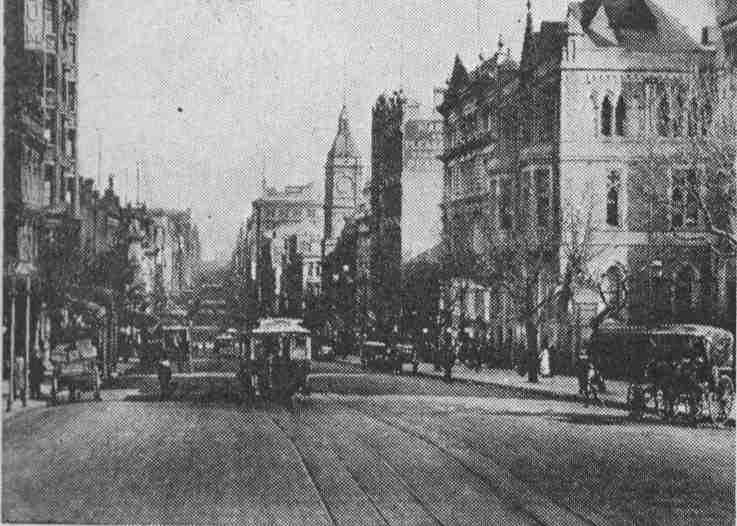
 Collins Street in the early 1900's (courtesy of Rail Page)
Collins Street is a major street in the Melbourne central business district and runs approximately east to west.
It is notable as Melbourne's best known street, with some of the country's finest Victorian era buildings.
Known as The 'Paris end' of Collins Street, the Eastern end is a part of Marvellous Melbourne mythology. Although modern development has destroyed some of the European flavour of the top-end of Collins Street it still retains designer boutiques and cafes. The length of Collins Street between Elizabeth and King Streets has long been the financial heart of Melbourne and is home to banks and insurance companies.
 One of the most breath taking buildings in Melbourne, if not on the outside, is probably 333 Collins Street Melbourne. The Atrium is one place you have got to see to believe. And, for your viewing pleasure, click HERE for a taste of it virtually. See...it does not disappoint.
 Festive time at The Block Arcade.
 One of our top tourist attractions is the Rialto Towers pictured above. Standing at 251 m (824 ft), this allows visitors to have a birds eye view of Melbourne, our Port Phillip Bay and, if it is a clear day, you can see as far as The Dandenong Ranges.
It is notable as Melbourne's best known street, with some of the country's finest Victorian era buildings.
Known as The 'Paris end' of Collins Street, the Eastern end is a part of Marvellous Melbourne mythology. Although modern development has destroyed some of the European flavour of the top-end of Collins Street it still retains designer boutiques and cafes. The length of Collins Street between Elizabeth and King Streets has long been the financial heart of Melbourne and is home to banks and insurance companies.
One of the most breath taking buildings in Melbourne, if not on the outside, is probably 333 Collins Street Melbourne. The Atrium is one place you have got to see to believe. And, for your viewing pleasure, click HERE for a taste of it virtually. See...it does not disappoint.Collins Street is named after Lieutenant-Governor David Collins who led a group of settlers in establishing a short-lived settlement at Sorrento on the Mornington Peninsula south of Melbourne in the early 1800s. He subsequently became the first governor of the colony of Van Diemens Land, later to be renamed Tasmania.
Festive time at The Block Arcade.Around the turn of the century "doing the Block" became a pastime for shoppers at the Block Arcade area in the retail heart of the street between Elizabeth and Swanston Streets.
The Bank of New South Wales Melbourne office earned architect Joseph Reed a first prize in architecture. When the building was demolished in 1935, the facade was transferred to the University of Melbourne to become the Commerce building, (now administration for the Faculty of Architecture, Building and Planning)
During the 1950s and 1960s, the street became subject to extensive redevelopment and many historic buildings were demolished by Whelan the Wrecker, despite the efforts of the National Trust and the "Save Collins Street" group. While some examples of boom style architecture survive, the grandest examples were lost to the wrecker's ball. Of the major losses, the most significant were the large Victorian buildings including the Federal Coffee Palace, Colonial Mutual Life building, Robb's buildings, Queen Victoria Buildings, City of Melbourne Bank, Scott's Hotel, Melbourne Mansions and APA building.
Between 2003-2005, Collins Street was extended west beyond Spencer Street, and currently ends in plastic barriers and a T intersection with Stadium Drive. It is expected to extend further west in the future, as part of the new Docklands redevelopment. This will create an intersection between Bourke Street and Collins Streets, two of Melbourne's most important streets.
The Bank of New South Wales Melbourne office earned architect Joseph Reed a first prize in architecture. When the building was demolished in 1935, the facade was transferred to the University of Melbourne to become the Commerce building, (now administration for the Faculty of Architecture, Building and Planning)
During the 1950s and 1960s, the street became subject to extensive redevelopment and many historic buildings were demolished by Whelan the Wrecker, despite the efforts of the National Trust and the "Save Collins Street" group. While some examples of boom style architecture survive, the grandest examples were lost to the wrecker's ball. Of the major losses, the most significant were the large Victorian buildings including the Federal Coffee Palace, Colonial Mutual Life building, Robb's buildings, Queen Victoria Buildings, City of Melbourne Bank, Scott's Hotel, Melbourne Mansions and APA building.
Between 2003-2005, Collins Street was extended west beyond Spencer Street, and currently ends in plastic barriers and a T intersection with Stadium Drive. It is expected to extend further west in the future, as part of the new Docklands redevelopment. This will create an intersection between Bourke Street and Collins Streets, two of Melbourne's most important streets.
One of our top tourist attractions is the Rialto Towers pictured above. Standing at 251 m (824 ft), this allows visitors to have a birds eye view of Melbourne, our Port Phillip Bay and, if it is a clear day, you can see as far as The Dandenong Ranges.There are also many gorgeous churches along the street, and if you take some time out to walk along and really look at each building you may find some treasures there..even if you have lived here for ages, sometimes things can go unnoticed. Oh, and if your feet get weary, don't fret, you can just hop on board a tram!


 Melba began to study and singing seriously after her marriage in 1882. Following appearances in Sydney and London, she made her operatic debut in Brussels in 1887. It was the start of a phenomenal 38-year career on the World stage.
 It was as 'the Voice' that Melba sometimes chose to describe herself. "Good singing", she stated, "is easy singing"; nature had given her an almost perfect larynx and vocal cords. Her range was fully three octaves, while her registers were so well blended that even an eminent throat specialist thought they were one. A scientific measurement of her trill produced twenty feet of undulations between perfectly parallel lines. Instrumentalists admired her, not least for the way that, despite her imperious temperament, she scrupulously sought to realize the composer's intentions.
  I could not leave you without having a link to have a listen to Dame Nellie Melba's voice could I? Nope..so