Showing posts with label Geelong Railway 150th Anniversary. Show all posts

Thursday, August 30, 2007

FRIDAY'S HISTORY LESSON:The City of Geelong.

Geelong is the second largest city in the state of Victoria, Australia and is the largest regional centre in the state. It is a port city with an urban population of approximately 161,000 people. Also it is one of the largest provincial cities in Australia. Geelong is located on Corio Bay, 75 kilometres south-west of the state's capital, Melbourne.
The city is a gateway to many renowned tourist attractions, namely the scenic Great Ocean Road, the Shipwreck Coast and the Bellarine Peninsula.
The explorers Hamilton Hume and William Hovell. They reached Corio Bay - the area of Port Phillip Bay that Geelong now fronts - on 16 December 1824, and it was at this time they reported that the Aborigines called the area Corayo, the bay being called Jillong (Hence the places now known as Cario and Geelong). Hume and Hovell had been contracted to travel overland from Sydney to Port Phillip, and having achieved this they stayed the night and begun their return journey the following day. William Buckley, an escaped convict from the Sullivan Bay settlement, lived among the Wautharong people for 32 years in the Bellarine Peninsula. Sighting of an old ship on Cario Bay.
1840 saw the first issue of The Geelong Advertisor Newspaper which still runs print today. 1850's saw the Goldrush increase population in Geelong from 8,000 to approximately 22,000. The port access a clear advantage.

The town of Geelong officially became a city on 8 December 1910. Electric trams began operation in 1912, travelling along Pakington St, Geelong West and the city centre until their demise in 1956.
Electric Car TRam Geelong 1912.


Between 1922 and 1925 Geelong's industrial growth began: three woollen mills, fertilizer plants and the Ford Motor Company's vehicle plant at Norlane. The Corio whiskey distillery (1928) and the Geelong Advertiser's radio station 3GL (now K-Rock) (1930) were opened.

Now Geelong is a popular Summer vacation spot and has everything you would wish for as a couple or as a family. Theme parks, the waters edge, carnivals, restaurants, museums and, if you don't fancy driving to Geelong there is a V-Line train service that can get you there from Melbourne. Remember our family train trip to Geelong recently?

Fond memories of wading in the water at Eastern Beach and eating ice cream and riding the old carousel ( manufactured in 1892) are mine to keep and yours to make!

Saturday, June 23, 2007

HISTORY POST...16


Tomorrow there will be a big haaa-hooo celebration because it is the 150th anniversary of the official opening of the railway between Melbourne and the city of Geelong...Werribee Station included in that line. This took place on the 25th of June 1857. At 64 kilometres, it was the first long distance country railway line in Australia and equalled the combined length of all other railways in the country.
Heritage diesel and steam trains will also operate on the Geelong line on Sunday 24 June. There will be Displays held at Geelong, Lara, Little River, Werribee and Williamstown. Train nuts will be out in force this weekend!!!


During the week, I will visit our Memorial Hall where I can gather some more info on our city and take some pictures. Tonight I will get info from local oldies who were born in the first hospital for this area....and right where that was located is a McDonalds now. That is progress!!!

Friday, June 15, 2007

FRIDAY'S HISTORY LESSON, My Home Town WERRIBEE....

The name Werribee is an aboriginal name meaning "backbone or spine". It is thought that this name was given as the shape of the Werribee River valley in the landscape looks like a backbone. The Werribee River seems to have provided a boundary between the territories of the Woiwurong aborigines to the north east and the Wothowurong to the south west, although other tribal groups visited the area. One of these tribes was the Yawangi tribe, whose last survivor "King" Bill Leigh died on Wooloomanata Station (on the Geelong side of the You Yangs) in 1912.


The You Yangs

The area of Werribee was first discovered by Hamilton Hume and William Hovell in 1824, they had traveled overland from Sydney to explore the Port Philip area.
Hume advised the then Governor of NSW that the area would be good sheep grazing land, but the Governor was not interested in the area, despite petitions by entrepreneurs John Batman and J.T. Gellibrand.
In 1835 Batman sailed from Van Diemen's Land (now Tasmania) and also explored the area between Geelong and Melbourne. He started a treaty with the local Aborigines in the name of the Port Phillip Association.
In 1835 this land was cut up in lots and settlers began setting up farms in the area.
The governor of NSW was not to pleased with the trespassing settlers, but finally caved in and sent Captain Lonsdale to the area in 1836 to survey and plan a town.

Lonsdale’s recommendation was to set up small town between Melbourne and Geelong and by 1850 the first land sale of the area began.
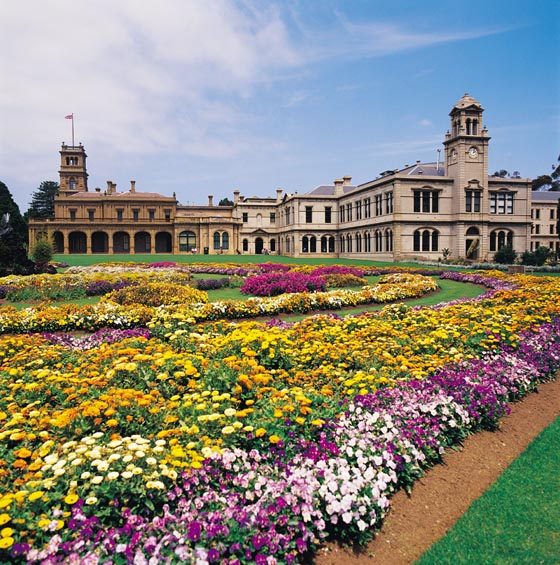
By 1857 the first rail line connecting Melbourne to Geelong passed through Werribee. By the 1890s Werribee had a population of around 500, its large flat expanses of land prompted several market gardeners to flock to the area to set up farms that can still be found around Werribee south today along with the Chirnside family mansion built around 1870.


Chirnside Mansion is the building to the left.
The Werribee record of white man and aboriginal contact is a sad one. In 1803, Lt Tuckey whilst on a survey mission in Port Phillip Bay from the Sorrento Settlement, shot on Werribee soil the first aborigine to be killed by a white man in Victoria. Years later, the first settlers killed by aborigines in Victoria - Charles Franks and a shepherd - were tomahawked to death whilst erecting a sheep hold near Mount Cottrell (Where I grew up) in 1836. Ironically, the tomahawks were part of the bargain that came with the signing of the treaty.


Mount Cotterell. As it is and remains today.

Early views of this part of Victoria were unfavourable with surveyors disappointed in the quality of the soil and the lack of trees. This was reported back to the ruling Government in NSW. Hume and Hovell, experienced pastoralists, came overland from NSW in 1824-5. They crossed the upper reaches of the Maribyrnong and came into the Werribee plains. They took back a glowing report to Sydney of the country that they had explored. The Hume and Hovell expedition camped in Werribee on 19 December 1824.
View of Melbourne from atop Cowie's Hill.
5 minutes drive tp Mt Cotterell.

John Batman and J.T. Gellibrand sent a petition to the Governor of NSW in 1827 asking for land in the Port Phillip district. Batman had been advised by Hamilton Hume that the Port Phillip area would offer good grazing land and all kinds of opportunities. The petition was refused because of the difficulties in administering the 'branch' colony so far from Sydney.
Batman and Gellibrand did not give up. They with other interested men formed the Port Phillip Association. In May 1835, Batman, representing the Association crossed Bass Strait and landed near Geelong. He explored the area from Geelong to Melbourne and was "lost in admiration of the possibilities of splendid sheep country".

In July 1835 John Helder Wedge, a member of the Port Phillip Association crossed Bass Strait to make a detailed survey and a plan to divide the land Batman had acquired. He divided the huge area of land into sections and lots were cast for it. Wedge was allocated Lot No. 13. Five of the seventeen lots were in the Werribee area.

In spite of the fact that the Governor of NSW made it clear they were trespassing, settlers from Van Diemans Land (now Tasmania), began arriving to take up the acquired land. Edward Wedge, brother to John bought out a flock of 400 merino sheep to the Werribee property. He built a house near the Werribee River but in 1852 the river flooded drowning Edward, his wife and daughter, Lucy.
John Helder Wedge (1793 - 1872),

As more settlers arrived in the Port Phillip area, the authorities in Sydney were forced to acknowledge its existence. The first step was to send officials to arrange for surveying and planning of a town. Captain Lonsdale, the first Police Magistrate of the Colony, took up duties late in 1836.

Lonsdale recommended in a letter to the Colonial Secretary that a village be surveyed and a few allotments sold "near the head of the boat navigation, which is half-way between Melbourne and Geelong". On September 6, 1850 the first sale of Wyndham took place. In 1857, the official opening of the Geelong and Melbourne Railway occured, furthermore making Werribee accessible for trade and for the community to travel between towns much easier. This year marks the 150th Anniversary of this opening of the Railway.


Werribee Railway Station, May 15th 1927, after a fire.

**********************To be continued next Friday*****************************